

Nowadays, physical music formats like vinyl, CDs, and cassettes are often seen as relics of the past. Yet, these formats have not only experienced a resurgence in popularity recently, but physical music formats, as well as merchandise, are crucial for the majority of artists. They not only help foster a deeper connection with their fans but also provide an additional revenue stream. While it might be easy to assume that physical formats are significantly worse for the environment compared to digital streaming, the reality is more nuanced. Our blog article explores the environmental implications of each format and challenges the common perception that streaming is more eco-friendly.
The Environmental Impact of Physical Music Formats
1. Vinyl

Vinyl records are made from polyvinyl chloride (PVC), a type of plastic that has significant environmental implications. The production of PVC involves the extraction of petroleum, contributing to greenhouse gas emissions and pollution. Additionally, the manufacturing process itself is energy-intensive. However, vinyl records are durable and can last for decades if properly cared for, potentially reducing the need for frequent replacements. The packaging of vinyl records typically includes paper sleeves, cardboard covers and plastic wrapping, which add to the overall environmental footprint. The weight and size of vinyl records also mean that transportation contributes significantly to their carbon footprint.
There are, of course, more environmentally friendly choices to be made when it comes to vinyl packaging, for example a “reverse board” option for all outer sleeves, where no lamination is used, making the outer sleeve more recyclable. As it has always been popular among the labels we work, we’ve taken it one step further by offering a 12” 3MM spine and 12” Gatefold outer sleeve printed on 350 gsm 100% recycled Nautilus paper. Furthermore, you can complete your vinyl release with a 12” bioplastic bag, instead of a plastic shrink-wrap.
2. CD/DVD

Compact discs (CDs) are made from a combination of materials, including polycarbonate plastic, aluminum, and various dyes. The production process, like that of vinyl records, is resource-intensive and generates emissions. However, CDs are smaller and lighter than vinyl records, resulting in lower transportation emissions. CDs are also very durable. CDs themselves are not easily recyclable due to the combination of materials used and often end up in landfills where they can take centuries to decompose.
While jewel cases were the dominant form of CD packaging in the early stages, there has been a clear shift towards cardboard sleeves over the past few decades. However, cardboard covers (for CDs as well as vinyl) are not necessarily more eco-friendly than plastic jewel cases because they are often foil-laminated, making them difficult to recycle. It is worth noting that plastic jewel cases (and MC boxes for cassettes) are easily replaced when broken. And for cardboard covers, if you want to opt for a more recyclable version, you can choose a “reverse board” (where no lamination is used).
3. Cassette
Cassettes, made from a combination of plastic and magnetic tape; the magnetic tape degrades over time, leading to a shorter lifespan and higher likelihood of disposal. The environmental impact of producing cassettes is resource-intensive as well, and their limited durability and playback quality mean they, in theory, are often replaced more frequently.. Similar to CDs, cassettes are smaller and lighter, resulting in lower transportation emissions. Their packaging typically involves plastic cases, contributing to plastic waste, but cardboard sleeves are also available as a more environmentally friendly option.

The Environmental Impact of Streaming
Streaming music might seem like an eco-friendly alternative to physical formats, but the reality is more complex. While it’s true that the production of physical media like vinyl records, CDs, and tapes involves significant use of plastics and packaging materials, the environmental cost of streaming is also substantial and often overlooked.

Data centers, the backbone of streaming services, consume vast amounts of electricity to store, transmit, and process digital music. This energy use leads to high carbon emissions, which are significantly greater than those produced by the manufacture and distribution of physical music formats.
A study highlighted that while plastic use in the recording industry has dramatically decreased—from 58 million kilograms in 1977 to just 8 million in 2016—the energy consumption required for digital music storage and streaming has led to a surge in greenhouse gas emissions. In 2016, emissions were estimated to be between 200 and 350 million kilograms in the U.S. alone. The physical spaces occupied by data centers also contribute to environmental degradation. These centers often require extensive land use, which can impact wildlife habitats and agricultural land. The cooling systems needed to maintain the servers consume additional energy and water, further exacerbating their environmental footprint.
Comparing the Carbon Footprint of Streaming Music vs. Physical Formats
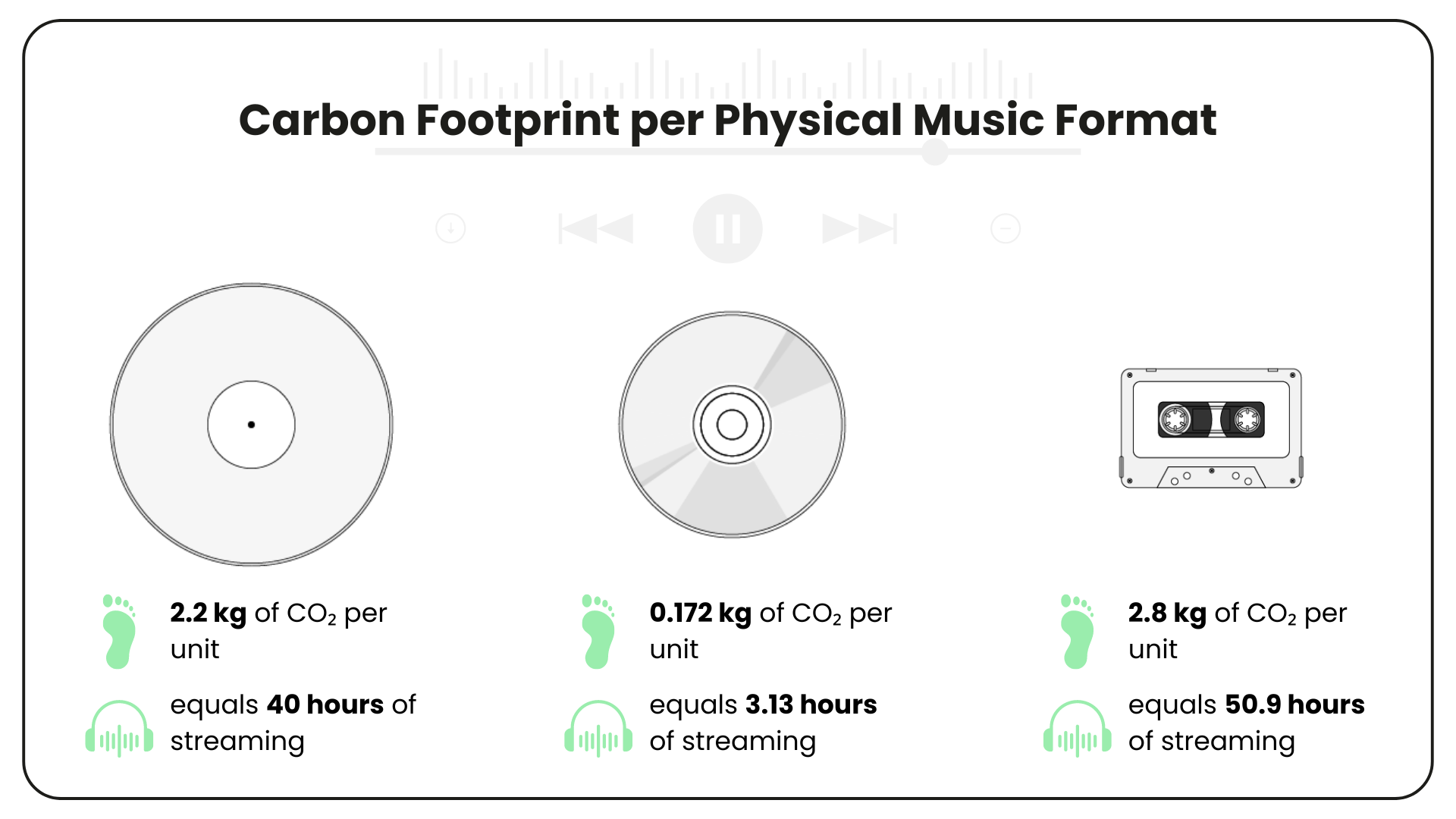
The carbon footprints of different physical music formats and digital streaming vary significantly. Vinyl records generate approximately 2.2 kg of CO₂ per unit, CDs produce around 172 grams (0.172 kg) of CO₂ each, and cassette tapes emit roughly 2.8 kg of CO₂ per tape. In comparison, streaming music has a lower carbon footprint, estimated at about 55 grams (0.055 kg) of CO₂ per hour of streaming. If we break this down, producing one vinyl record is equivalent to streaming about 40 hours of music. Producing one CD allows for approximately 3.13 hours of streaming, and one cassette tape equates to around 50.9 hours of streaming.
Considering that people spend an average of 20 hours per week streaming music, this results in about 80 hours of streaming per month, which generates approximately 4.4 kg of CO₂ per month and 52.8 kg of CO₂ per year.
What now? Streaming or Physical Formats?
When choosing between streaming music or using physical formats, each option has its advantages and disadvantages. Streaming music offers unparalleled convenience, allowing access to enormous libraries of songs anywhere with an internet connection. It generally has a lower carbon footprint per hour of listening, compared to the emissions from producing physical formats like vinyl records, CDs, or cassette tape. However, the infrastructure required for streaming, including data centers and servers, consumes significant amounts of energy, which can contribute to substantial overall emissions. On the other hand, physical music formats, while generating higher initial one-time carbon cost, do not require ongoing energy use after production and can last for decades with proper care, and their production is. A drawback of physical formats is the lack of convenience and accessibility, which may be a critical factor for many users. Who would want to run around with a portable CD-Player nowadays?
Ultimately, there is no definitive “right way” to consume music. The choice depends on individual priorities and personal preferences. However, end consumers, pressing plants, and data centers can all take steps to reduce their environmental impact while still enjoying music. End consumers can reduce their carbon footprint by downloading music for offline listening, which decreases the need for continuous streaming and thereby lessens energy consumption. Additionally, opting to listen to music on physical formats at home instead of streaming can also contribute to reducing energy usage. Pressing plants can adopt greener practices by using more sustainable materials and processes. For instance, switching to non-PVC materials for vinyl records, improving energy efficiency, and sourcing raw materials responsibly can significantly reduce environmental harm. Data centers can invest in renewable energy sources and improve their energy efficiency. Utilizing advanced cooling technologies, optimizing data storage, and supporting renewable energy projects can help mitigate the environmental impact of their operations.
By making conscious choices, both consumers and the music industry can contribute to reducing the overall environmental footprint of music consumption.
Start configuring your physical release now!



References:
- https://www.theguardian.com/music/2020/jan/28/vinyl-record-revival-environmental-impact-music-industry-streaming
- https://theconversation.com/the-environmental-impact-of-music-digital-records-cds-analysed-108942?utm_source=ActiveCampaign&utm_medium=email&utm_content=Are%20records%20more%20sustainable%20than%20you%20think%3F&utm_campaign=April%202024
- https://theclimatenews.co.uk/the-streaming-problem-has-music-become-unsustainable/
- https://www.newstatesman.com/environment/2021/11/how-environmentally-damaging-is-music-streaming
- https://expressiveaudio.com/blogs/audio-advent/audio-advent-day-1-the-environmental-impact-of-listening-to-music
- https://www2.deloitte.com/us/en/insights/industry/technology/how-streaming-is-changing-the-music-industry.html/#endnote-1
- https://www.cbc.ca/music/the-environmental-impact-of-music-streaming-explained-1.6843948
- https://www.forbes.com/sites/jamiehailstone/2022/04/22/is-the-resurgence-of-vinyl-records-good-news-for-the-environment/
- https://www.forbes.com/home-improvement/internet/streaming-stats/#:~:text=People%20spend%20an%20average%20of,to%20data%20from%20Exploding%20Topics.
- https://globalnews.ca/news/5150481/streaming-music-bad-environment/
- https://www.weforum.org/agenda/2019/02/streaming-music-isn-t-as-green-as-you-might-think-here-s-why/
- https://businessreview.studentorg.berkeley.edu/the-environmental-cost-of-music-streaming/